Saturday, 17 September 2011

Down Syndrome;Musculoskeletal Effects

Down Syndrome: Musculoskeletal Effects
Down syndrome is one of the most common genetic disorders. According to the Centers for Disease Control and Prevention, it affects about 13 babies in every 10,000 births. Its primary effect is mental retardation and a number of physical abnormalities.
The child may have special medical problems of the heart, stomach, eyes and other parts of the body. Some problems in Down syndrome involve the bones and joints (musculoskeletal system).
Symptoms


X-ray of the pelvis shows that the patient's left hip is dislocated.
(Reproduced with permission from Caird MS, Wills BPD, Dormans JP: Down Syndrome in Children: The Role of the Orthopaedic Surgeon. J Am Acad Orthop Surg 2006;14:610-619.)
A child with Down syndrome may have weak muscle tone (hypotonia). He or she may also have ligaments that are too loose (ligament laxity). This leads to excessive joint flexibility. Associated findings include:
  • Developmental delays. A child with Down syndrome will eventually reach the same growth milestones as other children. But, he or she may be slow learning to turn over, sit, stand, walk or do other physical activities.
  • Joint instability. Children with Down syndrome may have joints, such as the hip or knee, which slip out of place or become dislocated. Joint laxity in the neck may be excessive. This can lead to compression of the spinal cord.
  • Other Problems. Down syndrome may also lead to other problems, such as flat feet and bunions.
Nonsurgical Treatment
Getting early medical care and treatment (intervention) can improve the health of a child with Down syndrome and address some musculoskeletal problems.
Because children grow most rapidly during the first three years of life, it is important that the child have a comprehensive medical examination at birth.

Physical Therapy
The doctor may recommend a special program of physical therapy, exercise, and other activities early on. Early intervention can help a child with Down syndrome achieve developmental skills and build muscle tone and coordination. It can also give extra stimulation and encouragement to help the child achieve his or her full potential in life. Many children with Down syndrome go on to hold jobs and live independently well into middle age and beyond.
Early diagnosis and treatment is also important for managing orthopaedic problems in children with Down syndrome. Some children may need splints or other devices for physical activity. Sometimes your doctor may refer you to a pediatric orthopaedist for specialized help or surgery.

Neck Instability
In some people with Down syndrome, the upper part of the spine (cervical) is abnormal under the base of the skull. Muscles are weak and ligaments may be looser than they should be. Potentially, this can cause bones (vertebrae) in the neck to press on the spinal cord, leading to an inability to coordinate muscle movement and weakness.
Any progressive changes in a child with Down syndrome should be brought to the doctor's attention. These changes may include:
  • Weakness, clumsiness and tripping
  • Walking with stiff legs
  • Having a stiff neck, neck pain, and headaches
  • The doctor may recommend taking X-rays of your child's neck to look for joint laxity. In some cases, a child may be kept out of contact sports or other activities that put stress on the neck, such as high jumping, diving, gymnastics, and using a trampoline.

Staying Active
A child with Down syndrome should be encouraged to be physically active and consume a healthy diet. This will help them avoid excess weight gain and other physical problems. Your doctor can help develop a well-rounded exercise routine that includes aerobic activity, strength training, and stretching exercises.

Surgical Treatment
Occasionally, a child with Down syndrome may need a type of surgery called spinal fusion to hold the bones in the neck together. This will prevent excessive pressure on the spinal cord.
Surgery may also occasionally be needed to manage looseness of the hip and knee joints and looseness of the joints in the feet.

The Heart and Down Syndrome

The Heart and Down Syndrome - The Heart and Down Syndrome
The Heart and Down Syndrome

Abnormalities of the cardiovascular system are common in Down syndrome. Approximately half of all infants born with Down syndrome have a heart defect. Many of these defects have serious implications and it is important to understand them and how they may affect the child so that appropriate medical may be provided.

What are the most common heart defects in children with Down syndrome?

The most common defects are Atrioventricular Septal Defect (formally called Endocardial Cushion Defect), Ventricular Septal Defect, Persistent Ductus Arteriosus and Tetralogy of Fallot.


What is an Atrioventricular Septal Defect?

An Atrioventricular Septal Defect is caused by a failure of tissue to come together in the heart during embryonic life. This results in a large opening in the center of the heart, with usually a hole between the two pumping chambers (a Ventricular Septal Defect) and between the two collecting chambers (an Atrial Septal Defect) as well as abnormalities of the two atrioventricular valves, the mitral and tricuspid valves. Of those children with Down syndrome who are born with congenital heart disease, an antrioventricular septal defect is the most common. In less severe cases, Ventricular Septal Defects and Atrial Septal Defects can also occur separately.

What is Persistent Ductus Arteriosus?

The ductus arteriosus is a channel between the pulmonary artery and the aorta. During fetal life it diverts blood away from the lungs because prenatal blood is already oxygenated from the mother. After birth this channel usually closes on the first day of life. If it does not close, it is termed "persistent" and results in an increased flow of blood into the lungs.

What is Tetralogy of Fallot?


This is a term given to a heart condition composed of four abnormalities: 1) ventricular septal defect 2) a narrowing of the passage from the right venrtical to the lungs 3) an overenlarged right ventrical because of the backup of blood and 4) an overenlarged aorta, which carries blood from the left ventrical to the body.

What is the relationship of heart defects to the respiratory system?

The lungs of children with Down syndrome do not develop as fully as in the general population. Consequently, the growth of blood vessels throughout the lungs is limited. The narrowed arteries of the lungs hold potential for lasting consequences due to the increased pressure and flow of blood through the lungs.

How are the defects diagnosed?

Some children with Down syndrome and major heart defects will present with heart failure, difficulty breathing and failure to thrive in the newborn period; however, because in some children the defect may not be at first apparent, it is important that all children born with Down syndrome, even those who have no symptoms of heart disease, should have an echocardiogram in the first two or three months of life. Some heart conditions are also identified during prenatal ultrasounds.

What is the recommended treatment?

Heart surgery to correct the defects is recommended and it must be done before age five or six months in order to prevent lung damage. Although the complexity of the defects raises the risk of surgery slightly above that of surgery on children without Down syndrome, successful surgery will allow many children with heart conditions to thrive as well as any child with Down syndrome who is born with a normal heart. There may be residual defects (such as imperfect valves, in cases of Atrioventricular Septal Defect), but their effect on health is often minimal.

Alzheimer’s Disease and Down Syndrome

 Alzheimer’s Disease and Down Syndrome

Alzheimer's Disease, a degenerative neurological disorder characterized by progressive memory loss, personality changes and loss of functional motor capabilities, is far more common in individuals with Down syndrome than the general population. However, not all individuals with Down syndrome will develop Alzheimer's disease, and even those showing Alzheimer's-type symptoms may not have Alzheimer's disease since other conditions can mimic the symptoms.


How common is Alzheimer's disease in individuals with Down syndrome?

Estimates vary, but a reasonable conclusion is that 25 percent or more of individuals with Down syndrome over age 35 show clinical signs and symptoms of Alzheimer's-type dementia. The percentage increases with age. In the general population, Alzheimer's disease does not usually develop before age 50, and the highest incidence (in people over age 65) is between five and 10 percent. The incidence of Alzheimer's disease in the Down syndrome population is estimated to be three to five times greater than in the general population, and oftentimes, symptoms begin much earlier.  
What are the symptoms of Alzheimer's disease?
Early symptoms include loss of memory and logical thinking, personality change, decline in daily living skills, new onset of seizures, changes in coordination and gait, and loss of continence in bladder and bowel habits.
How is a final diagnosis made?
Alzheimer's disease is difficult to diagnose. It is important to be certain Alzheimer's-type symptoms do not arise from other conditions, namely thyroid disorders, clinical depression, brain tumor, recurrent brain strokes, metabolic imbalances and various neurological conditions.
The diagnosis of Alzheimer's disease is made on the basis of clinical history, showing a slow, steady decrease in cognitive function and a variety of laboratory tests which provide contributory evidence, including electroencephalogram, brain stem auditory evoked response, computerized transaxial tomography and magnetic resonance imaging, among other tests and measurements.
Is there a baseline test that can be repeated at intervals to determine specific decrease in cognitive function?

Psychologists often use questionnaires answered by family members, companions or caretakers that assist in the early detection of dementia. It is recommended that individuals with Down syndrome be tested at age 30 to provide a baseline reading, and periodically thereafter. If the tests show deterioration, further tests must be made to rule out conditions that present similar or overlapping symptoms.

What information has research yielded about a link between Alzheimer's disease and Down syndrome?

Current research investigating how certain genes on Chromosome 21 may predispose individuals with Down syndrome to Alzheimer's disease. A number of centers are testing therapies in Down syndrome that appear to benefit patients with Alzheimer's disease in the general population.

Wednesday, 14 September 2011

Down Syndrome ( Trisomy 21 )

Down Syndrome
Also called: Trisomy 21
 Down syndrome is set of mental and physical symptoms that result from having an extra copy of chromosome 21. Even though people with Down syndrome may have some physical and mental features in common, symptoms of Down syndrome can range from mild to severe. Usually, mental development and physical development are slower in people with Down syndrome than in those without it.

People with the syndrome may also have other health problems. They may be born with heart disease. They may have dementia. They may have hearing problems and problems with the intestines, eyes, thyroid and skeleton.


The chance of having a baby with Down syndrome increases as a woman gets older. Down syndrome cannot be cured. However, many people with Down syndrome live productive lives well into adulthood.
Facts about Down Syndrome

Down syndrome is a condition in which a baby is born with an extra chromosome. Chromosomes are small “packages” of genes in the body. They determine how a baby’s body forms during pregnancy and how, as the baby grows in the womb and after birth, the baby’s body functions. Normally, a baby is born with 46 chromosomes. Babies born with Down syndrome have an extra copy of one of these chromosomes. This extra copy changes the body’s and brain’s normal development and causes mental and physical problems for the baby.

 Even though people with Down syndrome might have some physical and mental features in common, symptoms of Down syndrome can range from mild to severe. Usually, mental development and physical development are slower in people with Down syndrome than in those without it.

Some common physical signs of Down syndrome include:
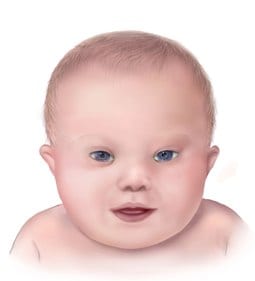
A flat face with an upward slant to the eye, a short neck, small ears, and a large tongue
Tiny white spots on the iris (colored part) of the eye
Small hands and feet
A single crease across the palm of the hand
Small pinky fingers that sometimes curve toward the thumb
Poor muscle tone or loose ligaments

What We Know About Down Syndrome 
How often does Down syndrome occur?

CDC estimates that each year about 6,000 babies in the United States are born with Down syndrome.1 In other words, about 1 of every 691 babies born in the United States each year is born with Down syndrome.

 What problems do children with Down syndrome have?

Babies and adults with Down syndrome can have physical problems, as well as intellectual disabilities. Every baby born with Down syndrome is different. In addition to the physical signs, some might have major birth defects or other medical problems. However, many people with Down syndrome live happy, productive lives well into adulthood.

Still, some physical problems associated with Down syndrome include:
A birth defect of the heart
Stomach problems, such as a blocked small intestine
Celiac disease, a digestive disease that damages the small intestine so that nutrients from food are not absorbed well
Problems with memory, concentration, and judgment, often called dementia
Hearing problems
Eye problems, such as cataracts or trouble seeing objects that are close by (far-sighted)
Thyroid problems
Skeletal problems

A person with Down syndrome can have an IQ in the mild-to-moderate range of intellectual disabilities. He or she also mighty have delayed language development and difficulties with physical coordination.


What We Still Do Not Know About Down Syndrome

What causes Down Syndrome?

To understand Down syndrome, it is necessary to understand how a baby develops. Each baby starts developing when he or she receives 23 chromosomes from the mother’s egg and 23 chromosomes from the father’s sperm. When a baby has Down syndrome, an error happened when either the egg or the sperm was formed. This error caused an extra chromosome (called chromosome number 21) in the egg or sperm, so that the baby received a total of 24 instead of 23 chromosomes from one of its parents. Therefore, the baby ends up having 47 chromosomes in every cell of his or her body, instead of 46 chromosomes. This extra chromosome causes the physical signs and additional problems that can occur among people with Down syndrome. The causes of the errors that produces the extra chromosome is not known.

The age of the mother is the only factor that has been shown to increase the risk of having a baby with Down syndrome. This risk increases with every year, especially after the mother is 35 years of age. However, because younger women are more likely to have babies than older women, 80% of babies with Down syndrome are born to women younger than 35 years of age.

CDC works with many researchers to study the risk factors that can increase the chance of having a baby with Down syndrome. Following are examples of what this research has found:
The number of babies with Down syndrome seems to be increasing, especially among mothers older than 35 years of age.2
Certain factors seem to influence how long a person with Down syndrome will live, including ethnicity, low weight at birth, and whether the baby was born with a heart defect.3
Death rates among Black or African-American infants with Down syndrome seem to be higher than death rates among White infants with Down syndrome.4 
 Can Down Syndrome be prevented?

There is no known way to prevent the Down syndrome. However, infants and children with Down syndrome often will benefit from special programs that help to improve their physical and mental limitations. These include speech therapy, occupational therapy, and exercises for physical coordination. Children with Down syndrome usually also need extra help or attention in school.

While there is currently no way to prevent Down syndrome, mothers can take steps before and during pregnancy to have a healthy pregnancy. Steps include taking a daily multivitamin with folic acid (400 micrograms), not smoking, and not drinking alcohol during pregnancy.

Saturday, 10 September 2011

Anxiety

Anxiety
Fear and anxiety are part of life. You may feel anxious before you take a test or walk down a dark street. This kind of anxiety is useful - it can make you more alert or careful. It usually ends soon after you are out of the situation that caused it. But for millions of people in the United States, the anxiety does not go away, and gets worse over time. They may have chest pains or nightmares. They may even be afraid to leave home. These people have anxiety disorders. Types include
Panic disorder
Obsessive-compulsive disorder
Post-traumatic stress disorder
Phobias
Generalized anxiety disorder

Treatment can involve medicines, therapy or both
Panic Disorders
Panic disorder is an anxiety disorder. It causes panic attacks, which are sudden feelings of terror for no reason. You may also feel physical symptoms, such as
Fast heartbeat
Chest pain
Breathing difficulty
Dizziness

Panic attacks can happen anytime, anywhere and without warning. You may live in fear of another attack and may avoid places where you have had an attack. For some people, fear takes over their lives and they cannot leave their homes.

Panic disorder is more common in women than men. It usually starts when people are young adults. Sometimes it starts when a person is under a lot of stress. Most people get better with treatment. Therapy can show you how to recognize and change your thinking patterns before they lead to panic. Medicines can also help.
Obsessive-Compulsive Disorder Also called: OCD
 Obsessive-compulsive disorder (OCD) is a type of anxiety disorder. If you have OCD, you have repeated, upsetting thoughts called obsessions. You do the same thing over and over again to try to make the thoughts go away. Those repeated actions are called compulsions.

Examples of obsessions are a fear of germs or a fear of being hurt. Compulsions include washing your hands, counting, checking on things or cleaning. Untreated, OCD can take over your life.

Researchers think brain circuits may not work properly in people who have OCD. It tends to run in families. The symptoms often begin in children or teens. Treatments that combine medicines and therapy are often effective.
Post-Traumatic Stress Disorder
Also called: PTSD
 Post-traumatic stress disorder (PTSD) is a real illness. You can get PTSD after living through or seeing a traumatic event, such as war, a hurricane, rape, physical abuse or a bad accident. PTSD makes you feel stressed and afraid after the danger is over. It affects your life and the people around you.

PTSD can cause problems like
Flashbacks, or feeling like the event is happening again
Trouble sleeping or nightmares
Feeling alone
Angry outbursts
Feeling worried, guilty or sad

PTSD starts at different times for different people. Signs of PTSD may start soon after a frightening event and then continue. Other people develop new or more severe signs months or even years later. PTSD can happen to anyone, even children.

Medicines can help you feel less afraid and tense. It might take a few weeks for them to work. Talking to a specially trained doctor or counselor also helps many people with PTSD. This is called talk therapy.
Phobias
A phobia is a type of anxiety disorder. It is a strong, irrational fear of something that poses little or no actual danger. There are many specific phobias. Acrophobia is a fear of heights. You may be able to ski the world's tallest mountains but be unable to go above the 5th floor of an office building. Agoraphobia is a fear of public places, and claustrophobia is a fear of closed-in places. If you become anxious and extremely self-conscious in everyday social situations, you could have a social phobia. Other common phobias involve tunnels, highway driving, water, flying, animals and blood.

People with phobias try to avoid what they are afraid of. If they cannot, they may experience
Panic and fear
Rapid heartbeat
Shortness of breath
Trembling
A strong desire to get away

Treatment helps most people with phobias. Options include medicines, therapy or both.


Friday, 2 September 2011

Hirsutism


Hirsutism is the condition which describes women whose hair is darker, thicker and coarser than the fine hair (vellous hair) that usually covers skin; more closely resembling head-hair (terminal hair). Hirsutism describes the growth of terminal hair in areas where usually only villous hair grows, such as the face, chest, nipples, belly and upper back. Affecting roughly 1 in 10 women, it is quite a common condition. However, not all women with more terminal hair on their bodies will have hirsutism, as some women from particular ethnic groups may naturally have more terminal hair. Hirsutism, conversely, is developed towards the end of the teenage years, and can get progressively worse, especially after the menopause. Furthermore, if you, or your child, have hirsutism, you may also have acne or seborrhoea (a condition where your skin produces too much sebum – an oily substance).

There are many reasons as to why women develop hirsutism, though as most aren’t related to medical conditions, it is often hard to determine a definite cause. This is known as idiopathic hirsutism. However, other medical conditions such as polycystic ovary syndrome (PCOS), obesity and diabetes can cause hirsutism, and it is also known to develop in women who possess too many androgens (male sex hormones), or whose hair follicles are more sensitive to androgens. It can also develop as a side-effect of taking some medicines, such as the contraceptive pill.

Though not painful or physically impairing, it can be very embarrassing and cause serious confidence and self-esteem issues. The good news is that there is a variety of ways to treat hirsutism, although it’s unlikely that any will entirely cure the condition. Some things which may help are: losing weight; eating healthily; exercising regularly; shaving; depilation; waxing; plucking and bleaching. Medicines such as anti-androgens, which work by blocking the action of androgen hormones, can also help, as well as the medicines metformin, finasteride and eflornithine. Electrolysis and laser treatment are also effective ways to remove hair and reduce hair growth.
Homeopathic Treatment;
Olium Jecoris 3,Pulsatilla 200 ,
For More details;hdaa09@yahoo.com


Acne

The common skin condition, acne, is often to blame, with around 80% of teenagers afflicted with some degree of acne between the ages of 13 and 18 years (although, a minority of cases may also start in adulthood). Commonly occurring on the face, arms, back and chest, acne occurs in puberty because of changes to hormone levels, which cause the sebaceous glands to produce, that blocks the hair follicles and causes spots ranging from blackheads to painful red nodules. Acne can often correct itself, but there are also a number of over-the-counter and prescription treatments available.
Homeo Treatment of ACNE ; 
Sulphur is perhaps the remedy most often indicated in this affection,
especially if chronic. The skin is rough and hard and the acne
is associated with comedones and constipation;  great aggravation
from water is the characteristic leading to **Sulphur in skin
affections. The acne punctata is the variety corresponding most
nearly to Sulphur. Simple forms yield to **Belladonna or Pulsatills.
Acne rosacea yields to *Arsenicum iodatum or Sulphur iodide.

#Sanguinaria [Sang]
is another useful remedy in acne, especially in women with scanty
menses and irregular circulation of blood. Other remedies for acne
dependent on sexual disturbances of women are **Calcarea carbonica
and Aurum muriaticum natronatrum.

#Kali bromatum [Kali.br]
produces an acne on the face, neck and shoulders. We frequently
find an acne in Epileptics who have been maltreated by bromides.
This remedy is especially adapted  to the acne simplex and the
acne indurata, especially in hyperaesthetic, nervous  females,
and the late Dr. Martin Deschere loudly praised it. 
Since **Kali bromatum has been found a useful remedy in sexual
excesses it will be especially a remedy in acne due to that cause.
Dr. J.H.Clarke says, "I know of no remedy of such universal usefulness
in cases of simple acne as **Kali bromatum 30," and the late Dr.A.M.
Cushing recommended
**Arsenicum bromatum 4x as very efficacious.
**Thuja is one of our best remedies for acne facialis.
**Calcarea picrata is also a useful remedy for acne; clinically it has
been found one of the good remedies. **Calcarea sulphurica is
indicated where the pimples suppurate.

#Antimonium crudum. [Ant.c]
Small red pimples on face, acne in drunkards with gastric derangements,
thirst and white-coated tongue. **Antimonium tartaricum. Obstinate
cases, with tendency to pustulation, are  curable with this remedy.
**Berberis aquifolium is useful where the skin is rough and the acne
persistent. **Natrum muriaticum acts especially on the sebaceous
glands, and is a very helpful remedy in acne.
In this affection attention must be directed especially to the
patient's type, temperament and tendencies and the general symptoms
are far mores important than the local ones.